abuse is a pattern of behaviour with the deign, intent or consequence, of making someone unable to leave a situation or relationship
Why do we need Model for Abuse in Polyamory?
The theoretical and cultural understandings of how abuse operates, presents and the impacts it has on individuals and communities, still not inclusive of the experiences of non-monogamous relationships. Services providers, literature and general information available about abuse assume a monogamous relationship, and as such individuals seeking support and information are just as likely to be alienates and ostracised as they are to be helped - polyamory or non-monogamy is likely to be understood as a symptom of the abuse or a tool of the abuser.
While many of the red flags and tactics of abuse may be similar to dyadic or monogamous relationships, without explicitly expanding our definitions and concepts to include non-monogamy, we allow tactics in non-monogamous relationships to become invisible and un-named. When something is unnamed, unlabelled or without reference, it becomes much harder to talk about it and call out abusive behaviour. And this is exactly what has happened. From the well-documented decades of abuse by Franklin Veaux, to the recent legal case against Eliot Winter for human trafficking and sexual assault, polyamory has become a hunting ground, refuge or fertile soil for men who wish to harm, control and exploit women.
The Duluth Wheel
|
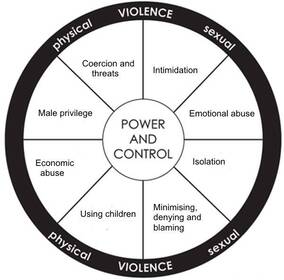
There is a need for tools to taxonomically catalogue, the various strategies used for abuse in polyamory and account for how they present in non-monogamous relationships. The Duluth Wheel of Power and Control is one such tool: a visual resource to aid us in a comprehensive understanding of the tactics used by abusers, and how these tactics interact to maintain control and power in a relationship. Poly Pages has been committed to creating a better understanding of abuse in polyamory. This model for abuse is patterned off of The Duluth Wheel of Power and Control. The model outlines examples in all eight areas of the Wheel of Power and Control, which are tactics used by abusers to maintain abusive situations in which sexual and physical violence become normalised.
History: In 1984, staff at the Domestic Abuse Intervention Project (DAIP) in Duluth, Minnesota began developing a curricula for groups on "men who batter and victims of domestic violence". They wanted a way to describe "battering" for victims, offenders, practitioners in the criminal justice system and the general public. Over several months, and through many focus groups with women who had been "battered" they documented the most common abusive behaviours or tactics that were used against these women. The tactics chosen for the wheel were those that were most universally experienced by victims of domestic assault and violence. The wheel is a product of it's time and so uses highly gendered languages, as-well as being very mono- and hetero- normative. This is a deliberate and concious choice by the DAIP who claims that the week "does not attempt to give a broad understanding of all violence in the home or community but instead offers a more precise explanation of the tactics men use to batter women."
|

| ||
abuse is a much more than physical or sexual violence
How to Identify Abuse in Polyamorous Dynamics
oly Pages has designed a list of red flags, in collaboration with The Network/La Red, to help individuals and communities identify abuse within their dynamics.
- Do you feel demeaned or humiliated?
- Are you unable to conduct private conversations with your partner/metamour?
- Do you feel pressured to have group sex to be part of your polycule?
- Do you feel pressured to accept an open relationship?
- Do you find yourself doubting your own grip on reality?
- Do you feel unsure of your status in your relationship, and unsure when or if to expect support or harm?
- Are you finding that the things your partner and your metamour say don't match up?
- Does your partner/meta claim to be the only/best source of information about polyamory or kink?
- Are you afraid of them?
- Are you getting distant from friends or family because they make those relationships difficult?
- Is your level of energy and motivation declining, or do you feel depressed?
- Is your self-opinion declining, so that you are always fighting to be good enough and to prove yourself?
- Do you find yourself constantly preoccupied with the relationship and how to fix it? Do you feel like you can’t do anything right?
- Do you feel like the problems in your relationship are all your fault?
- Do you repeatedly leave arguments feeling like you’ve been messed with but can’t figure out exactly why?
- Is your (digital) privacy disrespected regularly?
Some Tactics of Abuse in Polyamory
The Duluth Wheel offers us a way to understand the tactics of abuse in a structured way. We have provided examples below for each spoke of the wheel, including contextualised examples from polyamorous relationships.
|
emotional abuse
|
threats
|
economic abuse
|
|
using children
|
denial and blame
|
|
intimidation
|
isolation
|
using privilege
|
Abuse [in Polyamory]A global, live panel discussion 17th April 2021 10am LA | 12 Noon CHI | 1pm NYC | 6pm LON| 7pm PAR Ticketed Live Event Sliding Scale Prices (see below for details) |
Abuse can happen in any relationship, whether you have one partner, two partners, or even more. A polyamorous or non-monogamous relationship is not any more or less likely to be abusive than a monogamous one. Even though poly relationships are not inherently abusive, having multiple partners can create unique situations that abusive people may exploit.
Poly Pages is facilitating a global live event, featuring three polyamorous, seasoned sex and relationship coaches: Alicia Bunyan-Sampson, Eve Rickert and Sydney Raechin. This global event promises to outline what Abuse can look like in polyamory, how we can talk about it, and ways that we can respond to abuse in our relationships and in our communities. Our Early Bird Supporters, on Patreon, have access to this event for free (although are encouraged to tip) |